What Are AI Agents?
AI agents are software systems that can perceive their environment, make decisions, and take actions to achieve specific goals - with varying degrees of autonomy. Unlike traditional automation that follows rigid rules, AI agents adapt their behavior based on context and learning.
Think of the difference between a thermostat and a smart home system:
- A thermostat (traditional automation) follows simple rules: if temperature drops below 68°F, turn on heat
- A smart home system (AI agent) considers weather forecasts, your schedule, energy prices, and learned preferences to optimize comfort and cost
Key Characteristics of AI Agents
Autonomy: Agents operate with minimal human intervention, making decisions within defined boundaries.
Perception: Agents gather and interpret information from their environment through sensors, APIs, or data feeds.
Reasoning: Agents process information using AI models to understand situations and evaluate options.
Action: Agents execute tasks - sending communications, updating systems, controlling processes.
Learning: Advanced agents improve over time based on outcomes and feedback.
Types of AI Agents
Reactive Agents
The simplest type. They respond to current inputs without memory of past interactions.
Example: A spam filter that evaluates each email independently based on content patterns.
Best for: High-volume, stateless decisions where context doesn't matter.
Deliberative Agents
Agents that maintain internal models and plan multi-step actions to achieve goals.
Example: A supply chain agent that anticipates demand, monitors inventory, and coordinates orders across suppliers to optimize stock levels.
Best for: Complex processes requiring planning and coordination.
Learning Agents
Agents that improve their performance through experience.
Example: A customer service agent that learns from successful resolutions to handle similar issues more effectively.
Best for: Environments with patterns that can be learned and exploited.
Multi-Agent Systems
Multiple agents working together, each with specialized capabilities.
Example: A trading system where separate agents handle market analysis, risk assessment, execution, and compliance - coordinating to execute trades.
Best for: Complex domains requiring diverse expertise.
How AI Agents Work
The Perception-Action Loop
AI agents operate in a continuous cycle:
- Sense: Gather information from data sources, APIs, sensors, or user inputs
- Think: Process information using AI models to understand the situation
- Decide: Evaluate options and select the best action given goals and constraints
- Act: Execute the chosen action in the environment
- Learn: Update internal models based on outcomes
- Repeat: Return to sensing the environment
Under the Hood
Modern AI agents typically combine:
Large Language Models (LLMs): For understanding natural language, reasoning about complex situations, and generating human-like communications.
Tool Use: Ability to invoke external tools - search engines, calculators, APIs, databases - to gather information or take actions.
Memory Systems: Short-term memory for current tasks and long-term memory for learned knowledge and past interactions.
Planning Modules: Algorithms for breaking complex goals into achievable steps and adapting plans when circumstances change.
Business Applications
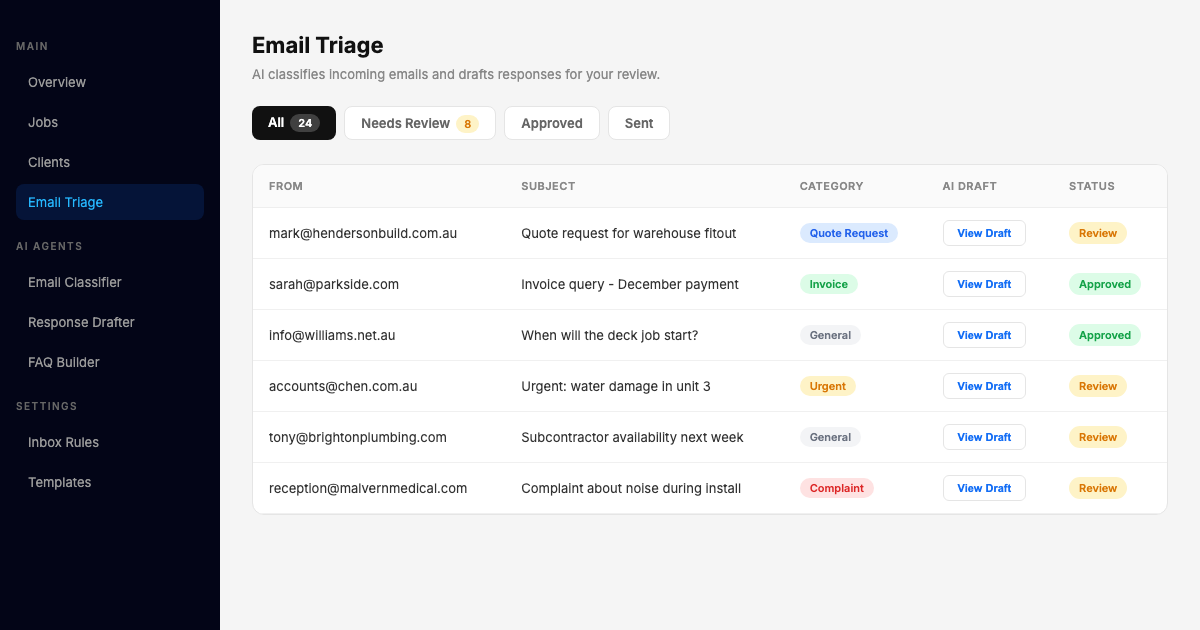
Customer Service Agents
AI agents handle customer inquiries across channels, resolving issues autonomously or escalating appropriately.
Capabilities:
- Answer product questions using knowledge bases
- Process returns and exchanges
- Update account information
- Schedule appointments
- Escalate complex issues with full context
Results: Companies report 40-60% reduction in support tickets requiring human agents, with higher customer satisfaction from instant responses.
Sales Development Agents
AI agents qualify leads and nurture prospects through early sales stages.
Capabilities:
- Research prospects using public information
- Personalize outreach based on prospect context
- Respond to initial inquiries
- Schedule meetings with human sales reps
- Follow up on stalled opportunities
Results: Sales teams report 3-5x increase in qualified meetings with the same headcount.
Operations Agents
AI agents monitor and optimize operational processes.
Capabilities:
- Track KPIs and alert on anomalies
- Coordinate workflows across systems
- Generate and distribute reports
- Manage routine approvals
- Optimize resource allocation
Results: Operations teams report 20-40% efficiency improvements and faster issue resolution.
Research Agents
AI agents gather, synthesize, and present information for decision-making.
Capabilities:
- Monitor news and market developments
- Compile competitive intelligence
- Summarize lengthy documents
- Generate research briefs
- Answer ad-hoc questions from data
Results: Research tasks that took hours now complete in minutes.
Implementation Considerations
Defining Agent Boundaries
The most critical design decision is determining what the agent can and cannot do autonomously.
Questions to answer:
- What actions can the agent take without approval?
- What requires human confirmation?
- What is completely off-limits?
- How do we handle uncertain situations?
Rule of thumb: Start with narrow boundaries and expand as trust builds.
Designing for Failure
AI agents will make mistakes. Your implementation must account for this:
Graceful degradation: When agents fail, they should fail safely and transparently.
Human escalation: Clear paths for escalating to humans when agents are uncertain or encounter novel situations.
Audit trails: Complete logging of agent decisions and actions for review and debugging.
Rollback capabilities: Ability to reverse agent actions when errors are discovered.
Integration Architecture
AI agents need to connect with existing systems:
Data access: Agents need read access to relevant data sources - CRMs, ERPs, knowledge bases.
Action capabilities: Agents need write access to systems where they take action - updating records, sending communications.
Authentication: Secure methods for agents to authenticate with external systems.
Rate limiting: Controls to prevent agents from overwhelming systems with requests.
Monitoring and Governance
Operating AI agents requires ongoing oversight:
Performance monitoring: Track agent success rates, response times, and error rates.
Quality sampling: Regularly review agent outputs for accuracy and appropriateness.
Anomaly detection: Alert on unusual agent behavior patterns.
Compliance logging: Maintain records required for regulatory compliance.
Building vs. Buying
Buy: Pre-Built Agent Platforms
Pros:
- Faster time to value
- Lower upfront investment
- Proven capabilities
- Vendor handles maintenance
Cons:
- Less customization
- Ongoing subscription costs
- Vendor lock-in risk
- May not fit unique workflows
Best for: Standard use cases like customer support, sales development, or scheduling.
Build: Custom Agent Development
Pros:
- Tailored to exact requirements
- Full control over capabilities
- No vendor dependencies
- Competitive differentiation
Cons:
- Higher upfront investment
- Longer development time
- Requires specialized talent
- Ongoing maintenance burden
Best for: Unique workflows, competitive differentiators, or tight integration requirements.
Hybrid Approach
Many organizations start with platforms to prove value quickly, then build custom capabilities for differentiating use cases.
Getting Started
Step 1: Identify Agent Opportunities
Look for processes that are:
- Repetitive but require judgment
- Time-consuming for skilled staff
- Variable in volume
- Currently bottlenecked
Step 2: Start Small
Choose a contained use case with:
- Clear success metrics
- Limited blast radius if things go wrong
- Stakeholders willing to experiment
- Sufficient volume to demonstrate value
Step 3: Define Guardrails
Establish boundaries before deployment:
- What can the agent do autonomously?
- What requires human approval?
- How will you handle errors?
- Who monitors agent performance?
Step 4: Measure and Iterate
Track performance from day one:
- Success rate of agent actions
- Time saved vs. manual process
- Quality of agent outputs
- User satisfaction
Use data to refine agent behavior and expand capabilities.
The Future of AI Agents
AI agent capabilities are advancing rapidly:
Increased Autonomy: Agents will handle increasingly complex tasks with less human oversight.
Multi-Modal Understanding: Agents will process images, video, and audio alongside text.
Improved Reasoning: Advances in AI will enable more sophisticated planning and problem-solving.
Standardized Frameworks: Tools for building agents will become more accessible and standardized.
Agent-to-Agent Collaboration: Agents from different vendors will work together through standard protocols.
Next Steps
Ready to explore AI agents for your business?
- Assess Readiness: Use our AI Integration Checklist to evaluate your current state
- Learn the Fundamentals: Read our guide on Workflow Automation to understand the foundation
- Talk to an Expert: Book a consultation to discuss your specific opportunities
AI agents represent a fundamental shift in how businesses operate. The organizations that learn to leverage them effectively will have significant advantages over those that don't.